Skills and Labour Data

How much will someone pay you for your skills? Is what I'm learning going to be valuable in the future? Which skills are in high demand or growing in demand?

This page is a collection of data from government and private reports to help you make sense of your skills. Not many students have access to this to guide their decision making - make good use of it.

View Source

Nesta Report: The value of Skills

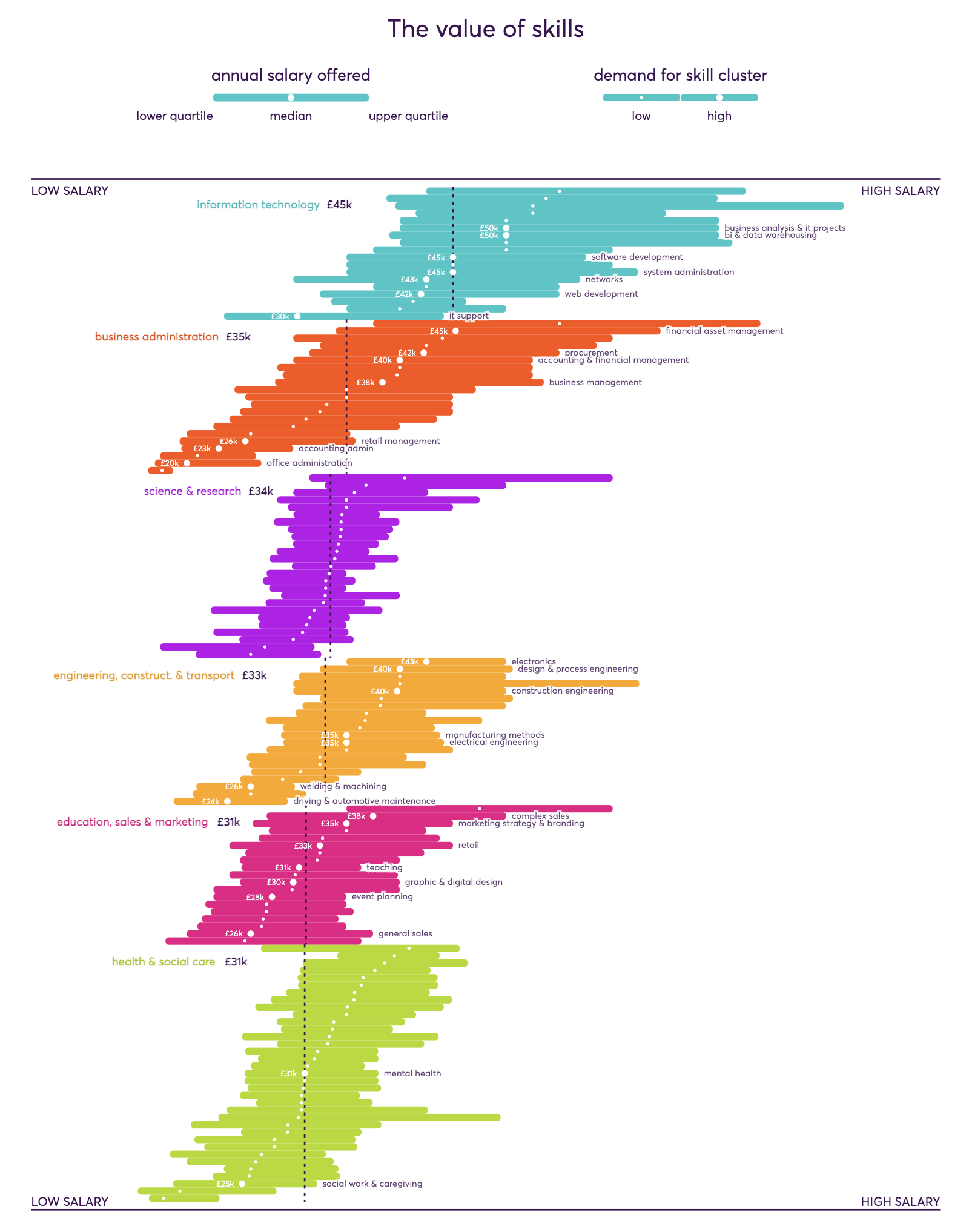
The chart shows the median annual salaries for each skill cluster in the third layer, as well as the lower and upper quartiles. These are estimates rather than precise figures, as only 61 per cent of adverts mention a salary. Despite this, these are the first estimates of skill values for the UK. To date, workers and students have had to decide between these skills without access to this information.

The five skill clusters at the third layer with the highest annual median salaries are:
- Data engineering
- Securities trading
- IT security operations
- IT security standards
- Mainframe programming

The five clusters with the lowest salaries are:- Premises security
- Medical administration
- Dental assistance
- Office administration
- Logistics administration

Get access to a skills support
network that's with you for life

Take ownership

The City as a School network is controlled by you– the learners– and the providers, a combination of individual teachers and learning centres. You choose when, where and how you learn.

Personalised support

Get flexible support depending on your unique needs and goals. You can start by joining one online community for free, then decide if you want to attend in-person events or work with an accredited learning guide.

Future-proof your career

The skills mix you'll needed for a successful career will change more frequently as technology changes the way we work and live. Use our tools and techniques to navigate all the career choices and information flying your way!

Solve real-world problems

Gone are the days of wondering 'Why am I learning this?!'. Apply what you know in 'Quests' and your own projects. Come up with your own solution to problems that our industry partners find in your city. Receive badges and awards for your ideas.

Social and community centric

There are communities for all kinds of interests, we call them 'Guilds'. Some are led by experts on our team, others are led by learners like you. Guilds curate resources, and are a great place to meet friends and collaborators. Join up up to 3 guilds and attend events in-person and online.

Counts towards university or career

CVs, diplomas and resumes can't communicate the details or depth of your knowledge. We use a learning record powered by the Mastery Transcript. Bring together pictures, videos, code, notes from online courses and badges issued by our industry partners to get into uni or land your next job.
Here's how it works

1. Create a City as a School (CAS) profile

Fill out an application including your goals, add to your portfolio your projects and work history.

2. Build a custom learning schedule

Explore what's on offer on your own or schedule a call with a City as a School guide if you want personalised support.

3. Accelerate your career and projects

Build your portfolio and get matched to jobs and opportunities with companies in your city or remote.

Early Access
Continued

Nesta Report: Growth in Demand for Skills

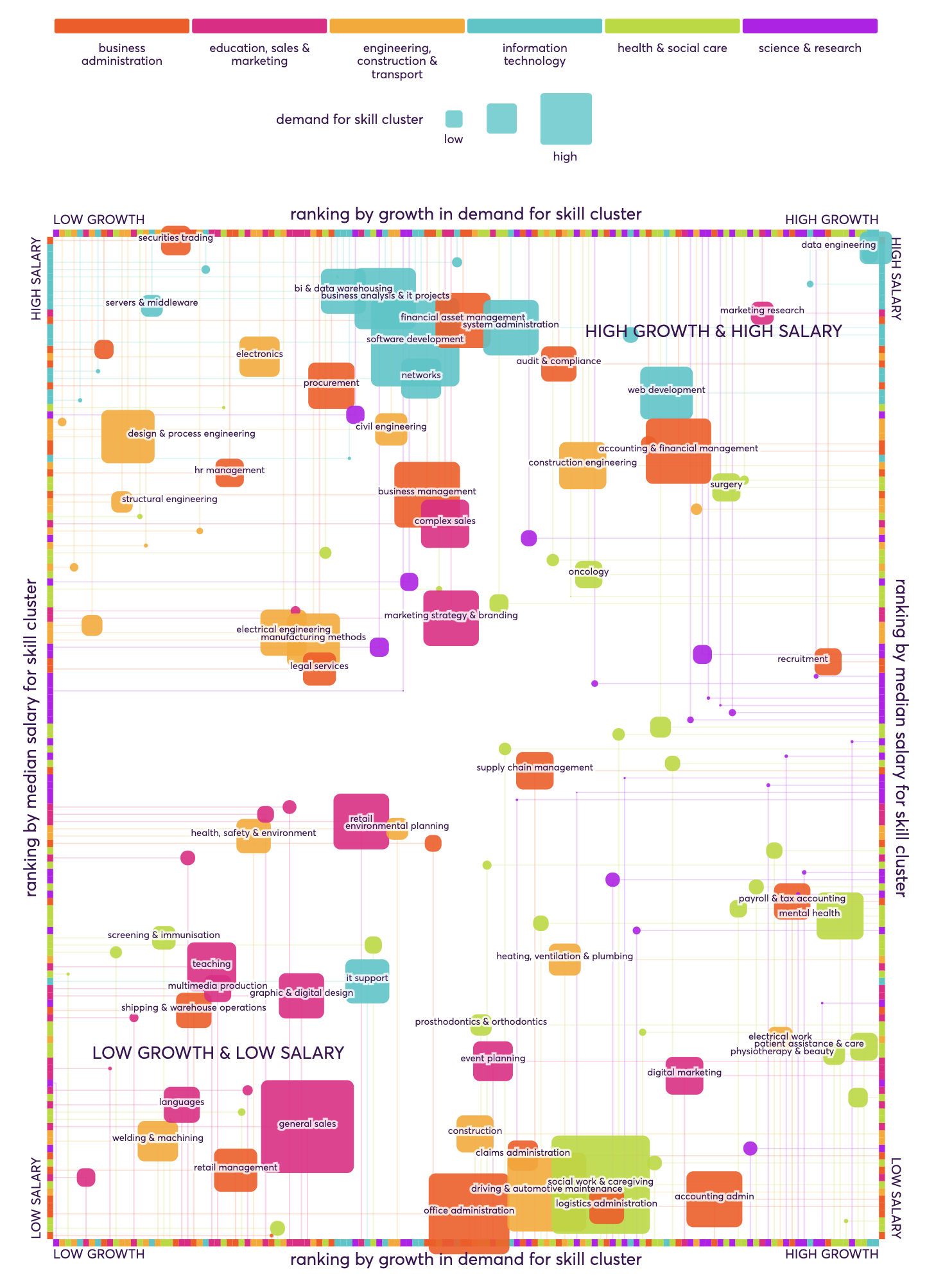
The chart below ranks the clusters in the third layer of the taxonomy, both by their value (salary) and by the growth in demand for their skills between 2012-2014 and 2015-2017.The clusters in the top-right hand corner of the chart have both relatively high salaries and high growth. They include data engineering, it security implementation, it security operations, marketing research, app development and web development. This may reflect a shortage in workers who have these relatively new skills.In the opposite corner of the chart are skill clusters with low salaries and low growth. Several require engaging with digital technology in a rather routine way, such as in shipping and warehouse operations, medical coding and administration and web content management.

Transferable skills are valuable, both to students, who may not have decided on a career path, and to workers, who can use these skills to transition between jobs. The data-driven methodology automatically identifies a set of 66 transferable skills prior to clustering, and these sit outside of the taxonomy.

FAQ

Question 1

Limitations of Nesta Report

↑

Limitations to consider

‍
No taxonomy will be truly comprehensive, whether it is derived from experts or created from job adverts, and moreover there is no single 'right way' to group skills. In this research, the most important limitation to remember is that not all work is advertised online. As a result, the demand for skills used predominantly by freelancers or by casual workers may be underestimated in the taxonomy. Despite this risk, the data-driven approach still creates the most detailed taxonomy of UK skills available to the public today. And it is more easily updated than expert-derived taxonomies.